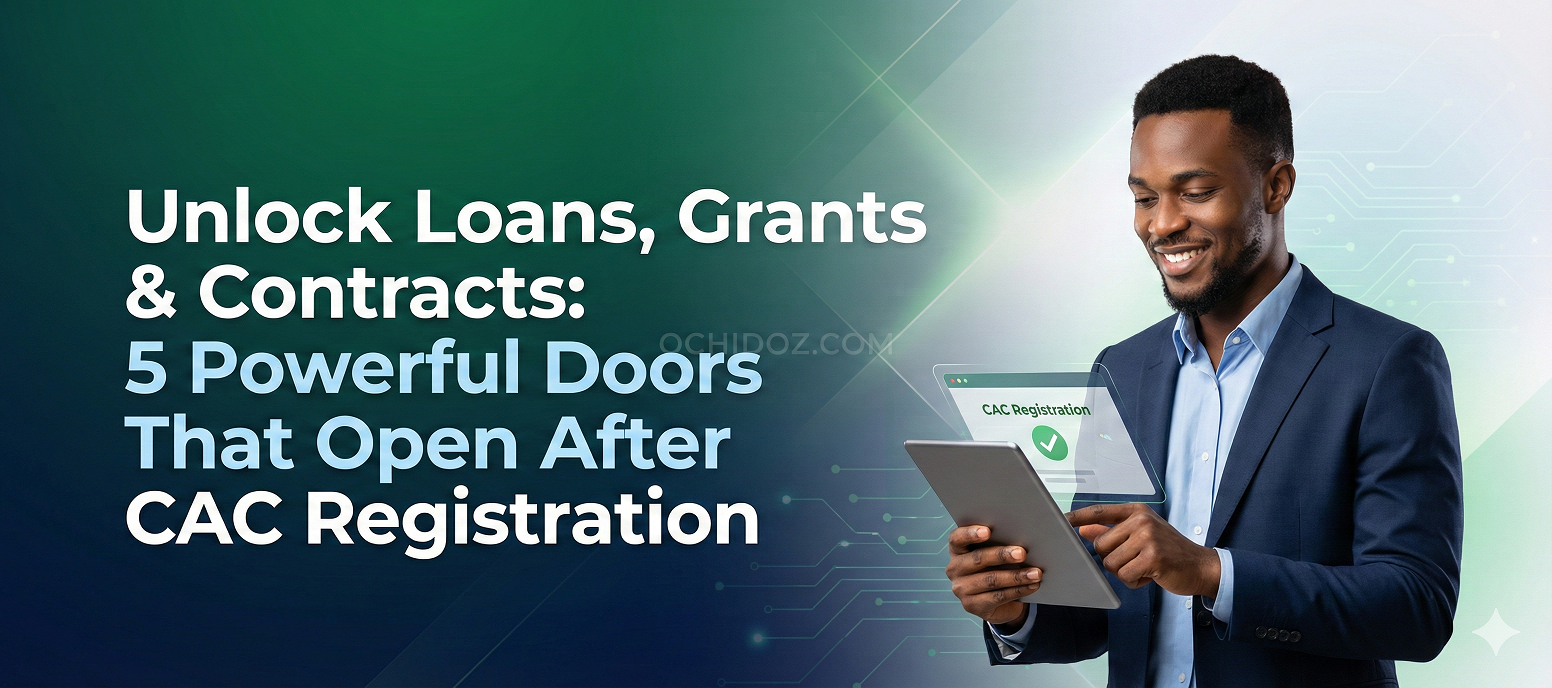
Unlock Loans, Grants & Contracts: 5 Powerful Doors That Open After CAC Registration
Every entrepreneur in Nigeria, from the bustling streets of Lagos to the thriving markets of Kano, shares a common goal: growth. You’ve poured your passion, sweat, and capital into building a business. But there comes a point where your individual effort isn’t enough. To scale, you need access to bigger opportunities—more funding, larger clients, and strategic partnerships. For many unregistered businesses, these opportunities remain tantalizingly out of reach, locked behind doors they don’t have the key for. That key is your Certificate of Incorporation from the Corporate Affairs Commission (CAC).
Viewing CAC registration as a mere bureaucratic hurdle is a critical mistake. In reality, it is the single most powerful tool for transforming your “hustle” into a structured, credible business entity. It is the master key that unlocks the doors to the loans, grants, and contracts that can catapult your business to the next level. Let’s walk through five of these powerful doors that swing open the moment your business is formally registered.
Door 1: Access to Business Loans from Commercial Banks
One of the most traditional paths to funding is a business loan. However, no Nigerian commercial bank will lend to a business that doesn’t legally exist. A registered business name or a limited liability company is the absolute, non-negotiable starting point.
Imagine Chidinma, a talented fashion designer in Surulere. Her ready-to-wear line is so popular that she can’t keep up with demand. To scale up, she needs to purchase three new industrial sewing machines, costing over 2 million Naira. She approaches her bank with her impressive sales records, but the bank manager stops her at the first question: “Where is your CAC registration and your corporate bank account statement?” Her entire business has been run through her personal account. The bank informs her that without a registered business entity, they cannot offer her a business loan, only a much smaller, high-interest personal loan. The door to affordable financing is firmly shut until she registers.
Door 2: Eligibility for Life-Changing Grants
Grants are essentially free money given to businesses to stimulate growth, innovation, or social impact. Nigeria has a growing ecosystem of government-led grants (like those from the Bank of Industry – BOI) and private foundations (like the Tony Elumelu Foundation). The first item on every eligibility checklist is proof of formal registration.
David, an agritech founder from Ibadan, develops a brilliant software to help farmers track crop yields. He sees an announcement for a major grant for innovative agricultural startups. The application form requires a CAC certificate number, a Tax Identification Number (TIN), and a business plan for “the company.” Because David had the foresight to register “AgroSolve Innovations Ltd” a year ago, he confidently fills out the application. His friend, who has a similar idea but remains unregistered, cannot even get past the first page. David’s registration makes him eligible for a grant that could fund his entire development phase.
Door 3: The Power to Bid for Corporate & Government Contracts
The most lucrative contracts often come from large corporations and government agencies. These organizations have strict procurement processes that require vendors to be registered, tax-compliant entities. They will not issue a Local Purchase Order (LPO) or a contract to an individual’s name.

Mr. Adekunle runs a small but efficient printing press in Shomolu. A multinational company on Victoria Island issues a public tender for the printing of their annual reports—a multi-million Naira job. To even be considered, all bidders must register on the company’s online procurement portal. The portal requires vendors to upload their Certificate of Incorporation, FIRS Tax Clearance Certificate, and other compliance documents. Because “Adekunle Prints & Co.” is a registered business, he can submit his competitive bid. Every unregistered printer in Lagos is automatically locked out of this high-value opportunity.
Door 4: Gaining the Trust of Investors and Partners
If you have ambitions of attracting angel investors, venture capital, or even bringing on a formal business partner, a registered company is not optional—it’s the entire basis of the deal. Investors put money into a legal entity, not just a person. They need a structure where ownership (shares) can be clearly defined, valued, and legally transferred.
Two young developers in Yaba, Amaka and Ken, create a prototype for a groundbreaking fintech app. They secure a meeting with an angel investor. The investor loves the idea but his first serious question is, “What is the corporate structure? Is the Intellectual Property (IP) owned by the company?” Because they registered “FinPay Solutions Ltd,” they can have a mature discussion about equity, valuation, and investment terms. If they were just “Amaka and Ken,” the investor would have told them to go register the business and come back, by which time he may have lost interest.
Door 5: Unlocking International Opportunities and Payments
In a globalized world, your market isn’t just Nigeria. A registered business is your passport to international credibility. It’s required to partner with foreign companies, build trust with overseas customers, and integrate with global payment gateways that facilitate international sales.
Sade sells exquisite, handcrafted Nigerian art online. She wants to tap into the lucrative American and European markets. To do this, she needs to accept credit card payments via international gateways like Stripe and PayPal. These platforms require verification of a registered business entity to open a corporate account. Her CAC registration allows her to set up these payment systems, open a domiciliary account, and present a professional, trustworthy front to international buyers, unlocking a world of new customers.
Stop seeing your CAC certificate as a framed document on the wall. See it for what it truly is: a master key. It’s the key that unlocks the doors to bank loans, government grants, corporate contracts, investor funding, and global markets. By operating informally, you are voluntarily leaving money and opportunities on the table every single day. The investment in formalizing your business is minuscule compared to the immense value of the doors it will open for you.
Ochidoz Ltd can handle your CAC registrations and Annual Returns Filing in Nigeria. Click here to send us a WhatsApp chat or give us a call at +2349061182744.